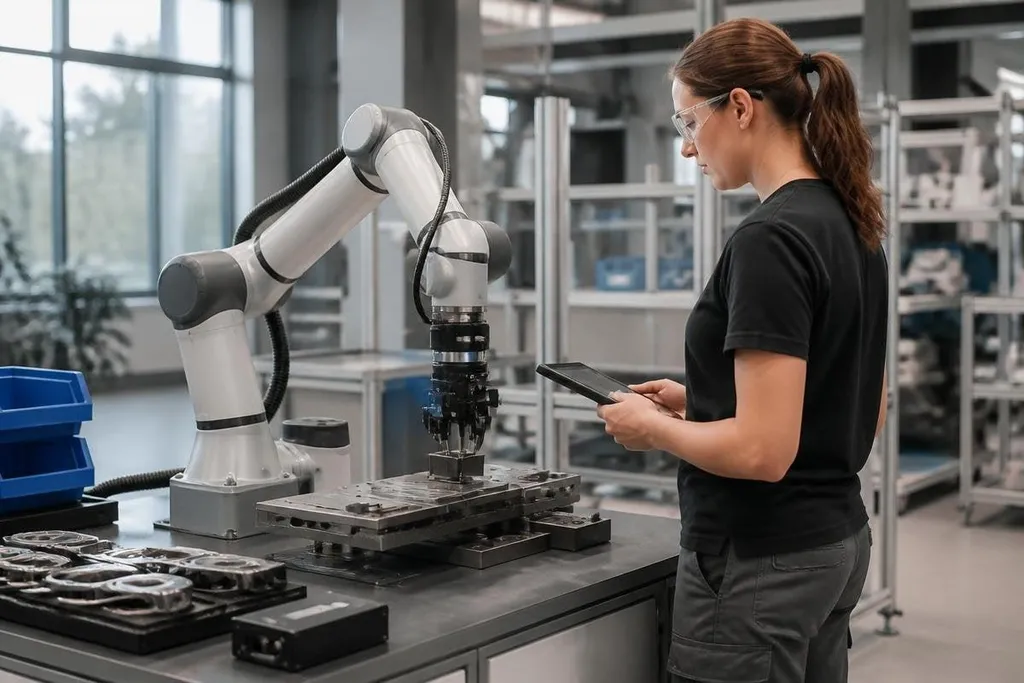
Collaborative robots are moving from simple shared workspaces into tasks that need more sensing, judgment, and recovery. The next stage will depend less on how close a person can stand to a robot and more on what the robot can do safely when work changes.
- Safer contact through force sensing and monitored stops
- Easier task changes for small production runs
- More proof that the robot can recover from mistakes
Safety has to work during real tasks
A cobot is designed to work near people, but safe operation depends on the full setup. The arm, gripper, software, tools, work surface, and task speed all affect the risk.
Force sensing can detect contact and stop motion. Safety-rated monitored stop can pause the robot when a person enters a defined area. Hand-guiding can let a worker move the arm and record a path.
These functions help, but each one needs testing around the actual job.
The hard part is predicting unusual contact. A soft object may crush or slip. A sharp tool can remain dangerous even when the arm moves slowly. A safe future for cobots will need clearer limits for complete work cells, rather than broad claims about the arm alone.
Setup time will shape the market
Many companies use cobots for tasks such as machine tending, packing, inspection, and light assembly. Those jobs often change with the product, batch size, or tool on the end of the arm.
That makes programming time a business issue. A worker may need to change a gripper, move a camera, teach a new path, and test the safety settings before production starts. Software that lets them adjust these steps without writing code could make smaller jobs practical.
The useful measure is the time from delivery to a repeatable task. A robot that takes a week to set up may fit a stable production line. A robot that can be moved and retaught during a shift has a different use, but that claim needs records from real sites.
Sensing must lead to better decisions
Cameras and force sensors give a cobot more information about its work. Information alone does little if the robot cannot tell a normal variation from a failed grasp.
A useful system should notice when a part is missing, when an object has shifted, or when a tool has not reached the expected position. It should then stop, retry within a defined limit, or ask a person for help. Each choice affects output and safety.
This is where the gap between a demonstration and a working cell appears. A short video can show a successful pick. A production system has to handle poor lighting, mixed parts, blocked views, and objects placed a few centimeters away from their expected position.
A cobot’s value depends on the work left after it stops, needs a new part, or meets a person in its path. Robot24.com robotics coverage can tie those handoffs to named machines, tasks, sites, and dates, giving a buyer better evidence before the worker’s role changes.
The worker’s role will change
Cobots are likely to take over more repeated movements, but people will still set goals, check quality, handle exceptions, and maintain the cell. That changes the training requirement.
A technician may need to understand tool changes, safety zones, sensor faults, and basic path editing. Operators will need clear signals when the robot has stopped and a simple way to restart the task after a fault.
The best systems will make these actions visible. A screen that shows the failed step and the reason for the stop is more useful than one that only displays an error code. I’d choose a slower cobot with clear recovery steps over a faster arm that leaves the worker guessing.
A practical buying check
Before choosing a cobot for a live task, check these points:
- Name the task: record the part, tool, cycle, and handoff the robot must repeat.
- Test the exceptions: move parts, block the camera, remove a component, and measure the recovery path.
- Check the cell: review the gripper, fixture, cables, sharp edges, and access points with the arm installed.
- Measure setup work: time a trained operator changing the tool, path, product, and safety settings.
- Plan the stop: define who responds, what the screen shows, and how the task restarts.
The next test for collaborative robots is clear: can a worker change a task, handle a fault, and keep the cell safe without calling a specialist each time? Companies that can answer that with site records will have a stronger case than those relying on a clean demo.